Posts

Showing posts with the label social Issues

Spanish Community Service Learning Lesson on Deportation and Private Detention Centers

Image
by Ann Abbott It was the week after spring break, and I had just returned from a wonderful yet long trip to Japan to see my daughter who is studying abroad in Nagoya. I was looking forward to seeing my students later that day, but I wasn't sure how I was going to make the class interesting and engaging. Scrolling through my Twitter feed, I found just what --and who-- I needed: @tanyaboza. I have followed Prof. Tanya Golash Boza's work for years: her blogs, her books, her articles. But it was only recently that I found her on Twitter. She is just as a smart and generous there as I had come to expect from her. She shared the series of videos about race and racism that she has developed for her students. She shares her publications and thoughts freely. And on the morning when I needed inspiration, she provided it in this tweet: I am pleased to share my latest publication with you, on how families experience the deportation of a loved one: https://t.co/DnStaA5mbJ p...

Ad-Hoc Interpreting in Spanish Community Service Learning and Other Contexts

by Ann Abbott Yesterday I gave a talk at the Law School here at the University of Illinois, Urbana-Champaign. It was for a meeting of the Immigration Law Society, a group of students interested in immigration law. I built the slides and the information on a talk I gave earlier this semester to the interpreters in the Champaign school district. Here are my slides: Interpreting: Language, Culture and Ethics by AnnAbbott If you would like for me to speak to your group about this, you can reach out to me at arabbott@illinois.edu or 217-333-6714. I was very interested in the student questions afterward. Some asked for more detail about ad hoc intepreting, but a lot of students were interested in knowing more about how to improve their language skills. For people who feel that their second language is rusty, I suggested doing a lot of listening and reading (input); then they can find opportunities to practice speaking. If you're watching movies or binging on Casa de Papel on...

Why Students of Spanish Should Prepare to Be Advocates

Image
Next year's conference will be in Salamanca, Spain. by Ann Abbott This year's annual conference of the American Association of Teacher of Spanish and Portuguese celebrated the 100th anniversary of our professional association. The inimitable and admirable Sheri Spaine Long invited me to participate on a plenary panel consisting of several people who had written essays or rejoinders for the centenary issue of Hispania that will come out in December of this year. It promises to be an expansive look at where we have come from and where we are going as a profession. I'd like to share below my presentation from the plenary. What do you think our challenges are as a profession? What do you think "Spanish" means today and for the future? Do you think that teaching Spanish in this political climate requires us to rethink anything we do? Or teaching it in this changing environment of higher ed? I'd love to hear your thoughts. ***********************...

Undocumented Immigrants: Invisible in Our Community, Invisible in our Curriculum

Image
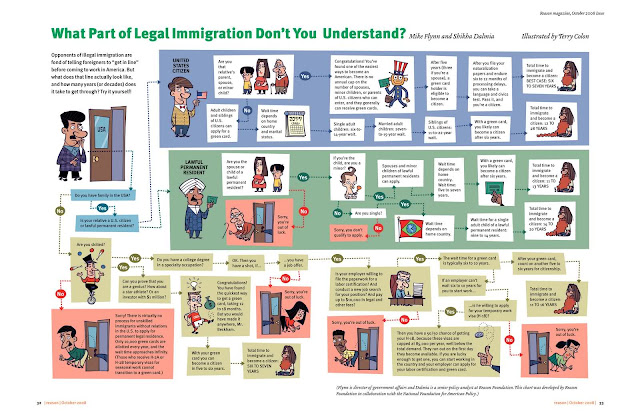
This flowchart makes the information very clear: there is no "legal path" for anyone except the very privileged. by Ann Abbott Florencia Henshaw invited me to speak to her students in SPAN 308 " Spanish in the US ," and I was delighted to do so. I think we need even more of an emphasis on Spanish in the US and that students need to understand better the complex realities of Spanish and Spanish speakers in the US. The topic of the week was "El e spa ñol en la vida pública." I don't know exactly how she was planning to frame that topic, but I decided to talk about our public discourse towards undocumented Spanish-speaking immigrants and our public policies related to them and their lives. I'll share my notes and resources below in a list format. I only had twenty minutes to talk, and I didn't take the time to structure this as a lesson like I normally would. But maybe something here will strike you and you could develop an actual lesson...

Experiential Activities for the Spanish Community Service LearningClassroom

Experiential actitivies for the csl classroom from Annie Abbott Because a lot of language educators believe that community service learning (CSL) is only for Spanish, it's so nice to be friends and colleagues with Deb Reisinger from Duke University who does CSL with her French students. (She also does business language studies and teaches social entrepreneurship; we have many, many things in common.) I'll be visiting her and her colleagues at Duke next week, and I'm excited to see their campus for the first time and learn more about their engaged scholarship and teaching projects. Although our universities are quite different (public/private) and in different places (small city Midwest/bigger city South), we actually are both part of the "New Latino Diaspora," a phenomenon that has the potential to radically shift how we teach Spanish in higher education in the US. (There might be a similar phenomenon for French speakers, particularly from the Fren...

Student Reflection

Image
by Nicole Tauster This semester for SPAN 332, in addition to volunteering, we formed groups and signed up for projects that allowed us to help community members/organizations with our Spanish skills. Some groups took over the social media campaigns for local organizations, others wrote grants or created fundraising events. My group did something a little different… We worked with Dr. Pilar Eg ü ez Guevarra, editing and transcribing videos for her. Dr. Guevarra has a webpage and project entitled “Comidas que Curan” and her goal is to inform the inhabitants of Esmeraldas, Ecuador about nutrition and how to use traditional foods in healthful ways. One of the growing problems in Esmeraldas is that products that the locals have used and consumed for years, like the coconut, are becoming more expensive due to gentrification and higher global demand. Because of this many people, especially the younger generations, were using less healthy substitutes for coconut oil, milk, etc. But Dr. ...

Cultural Appropriation and Spanish Community Service Learning

Image
by Ann Abbott Add this to the list of things I never thought I would be talking about while teaching Spansih community service learning: clothing. Yet this semester I have been confronted with issues of concern about clothing twice. Chief Illiniwek One day, in the third of the semester, one of my students walked in wearing a Chief shirt.  Oh, this was hard. I was frozen for a moment. I had two forces battling within me: Speak the truth. Always speak the truth. Confront racism. Be true to your moral compass. Call it out. Don't make a student lose face. Make your classroom a safe environment. (Safe for whom, though? Ugh.) We all make mistakes. Take care of things privately. I didn't do anything.  I didn't say anything. I didn't follow up in any way. What would you have done? This student is a lovely person. A Latino/a (I don't want to give away the gender). This student was the last person I would have expected to wear something offensive....

My Online Lesson about Social Entrepreneurship and Social Media Marketing

by Ann Abbott I was very happy to get an email this evening with a link to an online guest lesson I gave a few semesters ago about social entrepreneurship and social media marketing . Normally when you do a guest lecture, nothing remains from it afterward. This was my very first attempt at teaching online, and I'm glad to have a record of it. The course is called Social Media and Global Change, and you can see the course content on this blog . And for even more information, visit the Global Informatics Initiative website .

Student Reflection

Image
by Annette Popernik Una Ventana Hacia La Esperanza Imagínate estar enfermo de niño, ir al doctor, y cuando tengas que entregar los papeles, no tienes un número de seguro social. Tus amigos sacan sus licencias a los dieciséis años, pero tú no puedes sacar la tuya. Ellos empiezan a trabajar, pero tú no puedes. Cada día, hay el riesgo de que te deporten. ¿Por qué te pasa todo esto? Porque llegaste de niño a los Estados Unidos. Tus papás de trajeron. De niños, no tenemos un decir. Sin embargo, llegas a este país y tienes que sobreponerte, aún a los desafíos. El gobierno de los Estados Unidos decidió imponer un programa llamado DACA (Deferred Action for Childhood Arrivals o Acción Diferida Para Ciertos Jóvenes) para que los niños puedan tener oportunidades. En La Línea, frecuentemente nos encontramos con llamadas de hispanos en la comunidad quienes requieren información sobre DACA. Me rompe el corazón cuando le tengo que decir a un cliente que no cumple con los requisitos. No es...

Community Colleges in Illinois' New Growth Latino Communities

Image
Infrastructures for Spanish-speakers in new growth communities are a lot like this road. by Ann Abbott During the next few years, I will be working with the University of Illinois' Center for Latin American and Caribbean Studies (CLACS) on a project that they included in their grant renewal proposal and that apparently was well received by the reviewers: helping community colleges to implement Spanish community service learning. This semester, Dara Goldman, the Director of CLACS, and I began talking and brainstorming.  This could be, I told her, an opportunity to build a model of capacity-building, linguistic understanding and transcultural competence in new growth Latino communities. But it's not going to be easy... What is a new growth community?  The executive summary of a report by the Kaiser Family Foundation explains it in this way: This report examines coverage and access to care for Hispanics living in “new growth” communities (those with a small bu...

If you think everyone should just obey the law and respect authority...

by Ann Abbott I hate allegories. I'm going to write one, though. Dedicated to everyone who thinks it's all about obeying authority... You own a campus bar. (Substitute almost any small business; I just happen to be sitting on campus right now.) You become successful. You provide something that students enjoy, and you reap good financial rewards for what you have created. You're proud. You create jobs. You give back to the community. You and your family have a very comfortable lifestyle. Suddenly, the cops start spending a lot of time at your bar. They come in. They don't necessarily do anything, but they come in. Uniformed. They also sit in their cars outside your bar. Watching. Just watching. But sitting there. They stand outside the door. On the sidewalk. They talk to each other. If there's just one, he even interacts with people on the sidewalk. Just saying hi. How's it going? Uniformed. Friendly. There. It gives you the heebie jeebies. It gives your ...

Student Spotlight: Jesse Hoyt

Image
by Ann Abbott First things first: Jesse Hoyt was never a student in my class. But he was a student at the University of Illinois, and I ran into him a lot because of his work with La Colectiva at the University YMCA when I was more involved with CU-Immigration Forum at its beginnings. Most importantly, I think he is a former UI student that current Spanish students should get to know. He's a role model because of the career path he followed, and he's a expert in community organizing, grassroots organizations and immigrant rights. Here are several videos that I hope inform and inspire you. Listen carefully to find out where he worked after graduation (he has moved on now), look up the website and see if they have any job openings that could be a good fit for you. Now listen to his talk at the University YMCA's Friday Forum from the fall of 2013. You'll learn a lot about for-private jails and immigration reform, but you'll also see how professional and exper...

Student Reflection

Image
by Kelsey Marquez One Day  Sadness. Sadness is what I felt when I saw their innocent faces go from excited to disappointed. I will never forget the second time I went to volunteer at Garden Hills. When I walked into the nearly empty classroom, I came across an unfamiliar face. The stranger quickly introduced herself and said that she was the substitute teacher for the day and that the kids were still at Library. Within about five minutes, we went to pick up the children from Library and took them to get their vision tested. Up until that point, everything was pretty normal and going as usual. But soon that would change. The substitute teacher was an elderly Caucasian woman who didn’t speak a word of Spanish. For most classes, this would not be a problem, but this class is a bilingual kindergarten class. What does that mean? It means that the children are being taught in Spanish and know very little or no English at all. As we waited for the children to get tested, th...

Spanish Community Service Learning Students Interpreting at Parent-Teacher Conferences

Image
What would you do if you couldn't talk to you children's teacher? by Ann Abbott Parent-Teacher conferences are a crucial opportunity for families to communicate with the teachers and make concrete plans for their children's academic success. As a parent myself, I sometimes think of parent-teacher conferences as a way for us to influence how the teachers see and interact with our children: they know that behind each of children are two parents who are interested in their children's success, engaged in supporting their success at home, respectful of the teachers' work, and committed to advocating for our children. Imagine if you couldn't talk to your kids' teachers because you didn't speak the same language. What information about your child would you miss out on? What consequences might that have for your child? How might you be judged as a parent? Each semester, several of my students help at Central High School's parent-teacher co...