Posts

Showing posts with the label Spanish lesson plan

Spanish Community Service Learning Lesson on Deportation and Private Detention Centers

Image
by Ann Abbott It was the week after spring break, and I had just returned from a wonderful yet long trip to Japan to see my daughter who is studying abroad in Nagoya. I was looking forward to seeing my students later that day, but I wasn't sure how I was going to make the class interesting and engaging. Scrolling through my Twitter feed, I found just what --and who-- I needed: @tanyaboza. I have followed Prof. Tanya Golash Boza's work for years: her blogs, her books, her articles. But it was only recently that I found her on Twitter. She is just as a smart and generous there as I had come to expect from her. She shared the series of videos about race and racism that she has developed for her students. She shares her publications and thoughts freely. And on the morning when I needed inspiration, she provided it in this tweet: I am pleased to share my latest publication with you, on how families experience the deportation of a loved one: https://t.co/DnStaA5mbJ p...

Why Students of Spanish Should Prepare to Be Advocates

Image
Next year's conference will be in Salamanca, Spain. by Ann Abbott This year's annual conference of the American Association of Teacher of Spanish and Portuguese celebrated the 100th anniversary of our professional association. The inimitable and admirable Sheri Spaine Long invited me to participate on a plenary panel consisting of several people who had written essays or rejoinders for the centenary issue of Hispania that will come out in December of this year. It promises to be an expansive look at where we have come from and where we are going as a profession. I'd like to share below my presentation from the plenary. What do you think our challenges are as a profession? What do you think "Spanish" means today and for the future? Do you think that teaching Spanish in this political climate requires us to rethink anything we do? Or teaching it in this changing environment of higher ed? I'd love to hear your thoughts. ***********************...

Spanish and Social Entrepreneurship: Week 1 Lesson Plans

Image
by Ann Abbott I think it's really important to use the first day of class to set expectations and get students excited. I try to teach it as a typical class so that they know what to expect. However, I have learned over the years that for community service learning courses, it is a good idea to ease into things, to take one step at a time, to use class time to tie up the many loose ends this kind of pedagogy can create. I usually post my lesson plans on the UIUC Spanish Community Service Learning Facebook Page . Why? Because I post a lot of links that we then use during class for information and analysis. I also often have students write responses to my posts as a way to share their analyses, questions, etc. So look for the blue picture above that will accompany my lesson plans for this semester. With that in mind, here are my lesson plans for the first week of SPAN 332 Spanish and Entrepreneurship: Languages, Cultures and Communities. Week 1, Day 1: Presentación del cur...

Connecting College Students with Alumni: A Classroom Networking Project

Image
Look below to click on the links from the slide above. By Ann Abbott  On Friday I will give two talks. One is a noon-hour workshop on service learning, and the other is a quick description of a classroom project for our School's Share Fair . Here's what I will share in the second talk. Connecting Students with Alumni: A Classroom Networking Project Making the transition from language student to working professional can be a difficult and mysterious process to our current students. In my Business Spanish course, students work on a networking project that connects them to former students who were in their seats just a few years ago but are now in the working world. I will share the specific steps and resources I use for this activity—from researching alumni LinkedIn profiles to writing a “cold” networking email. This activity can be adapted to any language and any course.  On their end-of-the-semester course evaluations, several students listed this project as o...

Undocumented Immigrants: Invisible in Our Community, Invisible in our Curriculum

Image
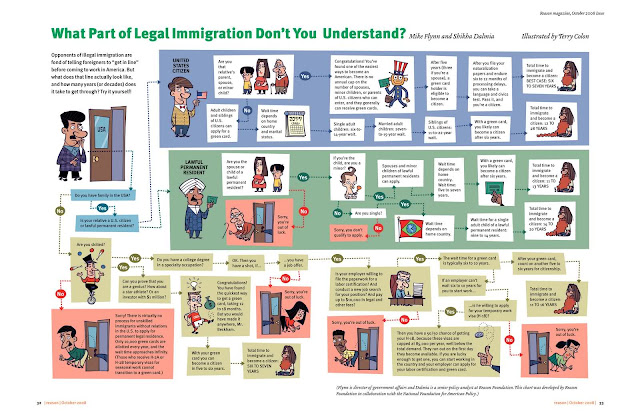
This flowchart makes the information very clear: there is no "legal path" for anyone except the very privileged. by Ann Abbott Florencia Henshaw invited me to speak to her students in SPAN 308 " Spanish in the US ," and I was delighted to do so. I think we need even more of an emphasis on Spanish in the US and that students need to understand better the complex realities of Spanish and Spanish speakers in the US. The topic of the week was "El e spa ñol en la vida pública." I don't know exactly how she was planning to frame that topic, but I decided to talk about our public discourse towards undocumented Spanish-speaking immigrants and our public policies related to them and their lives. I'll share my notes and resources below in a list format. I only had twenty minutes to talk, and I didn't take the time to structure this as a lesson like I normally would. But maybe something here will strike you and you could develop an actual lesson...

Experiential Activities for the Spanish Community Service LearningClassroom

Experiential actitivies for the csl classroom from Annie Abbott Because a lot of language educators believe that community service learning (CSL) is only for Spanish, it's so nice to be friends and colleagues with Deb Reisinger from Duke University who does CSL with her French students. (She also does business language studies and teaches social entrepreneurship; we have many, many things in common.) I'll be visiting her and her colleagues at Duke next week, and I'm excited to see their campus for the first time and learn more about their engaged scholarship and teaching projects. Although our universities are quite different (public/private) and in different places (small city Midwest/bigger city South), we actually are both part of the "New Latino Diaspora," a phenomenon that has the potential to radically shift how we teach Spanish in higher education in the US. (There might be a similar phenomenon for French speakers, particularly from the Fren...

Lesson Plan about Culture within Education Systems: Spanish Community Service Learning

Image
by Ann Abbott Here's an outline of my class today. The question we want to answer by the end of class is: ¿Sabemos cómo trabajar en la comunidad de manera culturalmente apropiada? Warm up In our last class we talked about mandatos -commands (Lección 5 in Comunidades: Más allá del aula ). So I´ll start with some Simon-Says-style commands, that they have to listen to distinguish if they are for the whole class or just one student. Levántate. Levántense. Salten. Salten dos veces. Da la mano a la persona a la par. Den la mano a la persona a la par. Siéntense. Lección 6 in Comunidades This lesson starts off with one of my favorite activities of all time: asking students how many continents there are. Then sharing with them how many continents other countries believe there are. This really hits home the idea that even things we think of as "facts," things we were taught in school as "facts," are embedded with our own culture and cultural val...

Spanish Community Service Learning: First Day of Class

Image
by Ann Abbott I have shared my first-day-of-the-semester lesson plans before. Here's the first day from last semester, focusing on the constant back-and-forth between big-picture learning and up-close-and-personal learning .  Here's the first day from one year ago .  I think the first day is really important. You have a chance to make a big impression. So I always teach. I don't go through the syllabus and tell them I'll seem them next time. So here's what I did on the first day of class of the Spring 2015 semester. It walked them through our never-ending cycle of class, community, class, community... Class I thanked students for signing up for this course. I know that it is an elective and that for many students it doesn't officially "count." It takes a special student to take one the unique work for this class and to show solidarity with a vulnerable community. Then I put them into pairs, told them to talk five minutes (hablar s...

Spanish & Entrepreneurship: Languages, Cultures & Communities

Image
by Ann Abbott I love teaching "Spanish & Entrepreneurship: Languages, Cultures & Communities." I focus the course on social entrepreneurship, I teach them basic business principles, we analyze them at work in specific nonprofit examples, and we focus on doing all of this in linguistically and culturally appropriate ways. Here's the syllabus for "Spanish & Entrepreneurship: Languages, Cultures & Communities ." On our first day of class this semester, I covered many of the fundamental elements of the course. Community service learning + social entrepreneurship The students in the course should already be familiar with community service learning, because the prerequisite for this course is " Spanish in the Community ." So they still need to work 28 hours during the semester with a community partner, but in class the academic content focuses on social entrepreneurship. Community service learning Despite the prerequisite, ...

Spanish in the Community: Dream Act, DACA and DAPA

Image
by Ann Abbott Last semester I set myself up for blogging failure: I said I would share all my lesson plans on my blog. Didn't happen. Too much going on, so I didn't always have time to sit down and write and share every single lesson plan. So this semester, no promises. When I can, I will. And I'd love to hear from you about your courses, lesson plans and class projects. Just as a reminder, you can contact me: Through comments on this blog. (Gracias, Carolina Egúsquiza, for being a friendly and helpful voice in the comments.) At work: arabbott@illinois.edu; 217-333-6714 On-line: Twitter @AnnAbbott ; Facebook Ann Abbott and my Page ( UIUC Spanish Community Service Learning ); Pinterest Ann Abbott And here's what I did with my students today. Students using their earbuds, listening to the videos. It's hard to see, but on the board I wrote: ¿Qué? ¿Y qué? ¿Ahora qué? ¿Qué? Informarse First I asked students if they knew who our Illinois Sen...

How To Translate a Community Partner's Document in the Classroom

Image
by Ann Abbott Translating gives me a headache. It's too hard. I never feel sure of myself. And even though I know that according to the rules you're supposed to translate from your second language (Spanish or Italian, for me) into your first language (English, for me), I also know that what our community needs desperately are translations from English to Spanish. My colleague Prof.  Anna María Escobar  received a request from a community organization for a translation. She asked if my students might be able to do it. Normally I would have said no, but instead I planned the lesson below. Note: One of my students (Cassie Grimm) is involved with a student start-up called  StudyCloud . I love to support student entrepreneurs, so this semester I am using StudyCloud as my course management system. As you'll see from the screen shots below, it works like Facebook in many ways and provides a much more visually-engaging learning experience than Blackboard. #1.  Firs...

Teaching Spanish Community Service Learning Students How to Participate in the Political Process

Image
Students formulated their own questions, then answered them. by Ann Abbott My "Spanish in the Community" students took their midterm exam last week, and now I am framing the second half of the semester in a slightly different way. I want to build a wider perspective into the class (looking at local, regional, national, and global dimensions of immigration) and most importantly: show students that the knowledge we gain in classes (and life) can be put to use to do something . So here's how today's class was structured. I shared  Illinois Coalition for Immigrant Refugee Rights'  press release about Senator Dirk Durbin's  Call for Administrative Relief from Deportations , and asked students to simply read it. Unless you are fully steeped in immigration reform and the issues that surround it, the press release raises questions. So I put students into pairs and told them to generate a list of at least ten questions they had about the information in th...