Tuesday, November 23, 2010
Student Reflection
Posted by
Ann Abbott
at
10:55 AM
0
comments
Labels: Spanish community service learning, student reflections
Thursday, November 18, 2010
Student Reflection
Posted by
Ann Abbott
at
8:00 AM
0
comments
Labels: Spanish community service learning, student reflections
Wednesday, November 17, 2010
Business Spanish: Marketing Research Course Project
My business Spanish students are working on a marketing survey related to University of Illinois students and their habits (if any) of going out to bars and restaurants in downtown Champaign.
We're at the very beginning stages, and we'll document our results on our project wiki as we go. On the wiki, you can see the set of questions, and students have to get answers from five University of Illinois students. The results will be shared with owners of bars and restaurants in downtown Champaign.
Today we compiled the data from the 68 surveys that had been turned in so far. In the end, we should have completed 130 surveys.
But before we began compiling the data, I put students in pairs and asked them to use their first impressions and their intuitions and write down the following: What do you think are going to be the three most important results that come out of this marketing research? When we're done with the project, I want them to look back and see if their intuitions and first impressions were correct. I imagine they will be. After all, they belong to the niche market that we're studying.
Here are some of their answers:
- Word of mouth is very important when students decide which bars or restaurants to go to.
- Many students do not want to go far off campus.
- Students communicate by text when deciding where to go.
- Many people use the Facebook pages of their friends and the bars and restaurants when deciding where to go.
- Most students don't read university publications.
- Students like to go to busy places.
- Students spend about $20 per weekend.
- Students value most their friends' opinions of good places to go to.
- Many people use apps on their telephones when making decisions.
- The "Black Sheep" is a popular newspaper.
- Students do want to go to downtown Champaign because they have hear good things about it.
- Students will go wherever their group of friends wants to go.
New Book Full of Creative Ideas for Service Learning
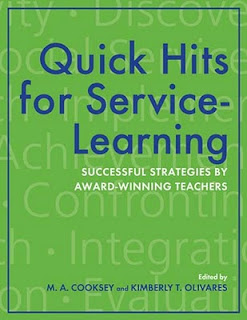
I was excited to get my copy of the new book, "Quick Hits for Service-Learning: Successful Strategies by Award-winning Teachers" (U of Indiana Press), in my mailbox yesterday.
My piece (written with Darcy Lear) is entitled "Matching student presentations to the nature of service-learning work." In it, we describe how students can do poster presentations instead of the more familiar oral presentations. The intro states:
"Each semester, our Spanish service-learning students engage in meaningful community-based projects, yet the typical end-of-the-semester oral presentation is the opposite: boring and delivered to a passive audience. Without extensive training, most PowerPoint presentations simply recreate the pitfalls of oral presentations with students reading each slide's text. Instead, we have found that a poster session modeled on the professional conference format allows students to present their projects in succinct yet eye-catching posters that necessitate active dialogue with their audience." (80)
The pieces included in this book are all very brief and intended as "descriptions and directions offered for your reference and study as you map out your more specific curricular plan." (M. A. Cooksey & Kimberly T. Olivares, "Editors' Introduction")
Some pieces that might be of interest to Spanish service learning practitioners include:
- Increasing cultural competency through refugee focused service-learning projects: Bringing the world home
- International Service-learning (ISL): Creating an intersession social work course in India. (Although this is not about work with Spanish-speakers, short-term study abroad is becoming increasingly popular in all languages.)
- Developing a resource manual for new immigrants
- Learning beyond the classroom: A Spanish for the Professions course
- Partnering with the community to bridge the language classroom to the Latino population
Monday, November 15, 2010
Student Reflection
Posted by
Ann Abbott
at
8:17 AM
0
comments
Labels: Spanish community service learning, student reflections
Sunday, November 14, 2010
Student Reflection
Posted by
Ann Abbott
at
8:47 AM
0
comments
Labels: Spanish community service learning, student reflections
Friday, November 12, 2010
Assessing Transcultural Competency in Community Service Learning
After the webinar presentation I gave last week ("Achieving Transcultural Competence through Community Service Learning"), I received several questions about assessment.
My initial reaction was, and remains, that structured student reflection should be the centerpiece of that assessment. After all, it's already a part of any well-designed CSL course, and our prompts can ask students to analyze any number of elements of transcultural competency:
- Recognize and describe moments of cultural difference.
- Notice and describe the emotions that often accompany transcultural (mis)encounters.
- Discuss the results of a particular experience when the student used cultural information in the community that he/she had learned about in the classroom, in other coursework or from other sources.
- Present a possible worst-case scenario following an instance of transcultural incompetence in the community partner organization.
- Etc.
- Write brief response paper to an academic reading on transcultural competency.
- Make a list of questions that they have about the concept of transcultural competency. Follow those questions with ideas about how they could research and answer them. (After all, it is a rather complex concept and difficult to put into practice.)
- A photograph of themselves with explanations about the cultural significance of various items they are wearing (e.g., fraternity symbols, brand logos, school colors, athletic items, international items, fair-trade items, etc.). The same thing with a photograph of a person from another culture.
- A reflective essay addressing any of the prompts from the list above.
- There are many other possibilities!
Monday, November 8, 2010
Student Reflection
For the past month now, I’ve been helping the catechism classes at St. John’s Catholic Newman Center, volunteering as a kind of “teacher’s assistant” during classes that prepare the Spanish-speaking kids of the community to receive their First Communion, a sacrament in the Roman Catholic Church. I decided to use this opportunity as my “trabajo en la comunidad” for a few reasons. I am Catholic and my faith is very important to me- I think that’s pretty important for a religious education teacher! I also live at the Newman Center so I only have to walk downstairs every Saturday morning to get to work. Plus, my freshman year of college, I also worked with the catechism classes, doing pretty much the same thing except with a different teacher. I enjoyed it very much and I knew what I could expect for class this year!
Saturday, November 6, 2010
More Questions about Transcultural Competency
by Ann Abbott
I had a few more follow-up questions from Friday's webinar that I answered on the e-mail. I thought I would share the questions and answers here. You know how it is: if one person asks the questions that means that at least ten others had the same questions but just didn't ask it.
Question: My first concern is what does trans-cultural competence mean?
Answer: Definitions and terms vary. Cultural competency really comes from the health professions, especially nursing and social work, where they emphasize that in order to provide effective care, a person needs to know about other cultures' beliefs in order to provide care that works. For example, if you provide nutritional counseling to a person from another culture that has been diagnosed with diabetes and give them a diet plan that only includes typical US dishes, that does not show cultural competency and it will probably not be effective. The business world has their own definitions of intercultural competency as well. However, I think, at its essence, transcultural competency means that you are aware of your own cultural perspectives and those of other cultures and that you can use that knowledge to have effective communication and interactions with people of other cultures.
Question: Since having trans-cultural competence is part of the goals of language, literature and culture classes, is it possible to teach trans-cultural competence as a course?
Answer: You certainly could choose to teach a course on transcultural competency. That would be very interesting and valuable! However, I don't think it is absolutely necessary. You could choose to do activities with your students in any foreign language course to make them explicitly aware of it as a concept and to practice it. This is where I believe CSL is so valuable--in a traditional classroom you would probably talk about transcultural competency, but when students work in the community they can connect the theory to what they are actually doing when they work with native speakers of the target culture(s).
Question: If your answer is Yes, What are the competences the students have to pursue? How do you assess those competences?
Answer: This depends. In my university, I would want my students to learn a mindset (awareness, observation, asking questions, etc.) that they would bring to bear on any transcultural interactions they might have. If, however, I were teaching a Spanish for veterinarians course, I would choose competencies that professionals in that field would need. For example, if they will be working with Latino immigrants who take care of cattle, I would talk to them about potential literacy/illiteracy among workers, attitudes towards authority, how they might ensure that their instructions have been understood even if people don't want to admit that they haven't understood, etc.
To assess these competencies is a challenge! I would use reflection as a starting point. I would ask students who have worked in the community to identify an instance when they felt that their cultural expectations were not shared by another person and to reflect on how they handled it and how they might handle it in the future. Or I might give them a written case that describes a situation that requires transcultural competency and ask them to analyze it.
Question: I was thinking about doing CSL abroad. What type of critical thinking issues would you implement in an Internship abroad?
- schedules and concepts of time, especially if students are working in an office that they expect should "keep hours" the way they are used to or if they need to make appointments with people.
- another issue related to time is, how do they define successful CSL work? If they are in the country for a short time, will they be able to see the value of the work they have done on a small piece of aa potential longer-term project?
- complexity, as in, when you try to solve a "big" problem (poverty, access to quality education, community organizing, etc.) or a piece of it, problems will arise. We can help students to grapple with "messy problems" and the lack of closure they may desire but not gain.
- along with all these big-picture, critical thinking issues, don't be surprised if you find yourself really addressing what you consider to be small things. I never imagined I would need to spend time on numbers and the alphabet with my students! Yet I do. And such small things actually contain a world of complexity.
Achieving Transcultural Competence through Community Service Learning
- ACHIEVING TRANSCULTURAL COMPETENCE THROUGH COMMUNITY SERVICE LEARNING Foreign language community service learning (CSL) addresses ACTFL's "Communities" goal area when students use the target language in the community to both learn and serve. This allows instructors to move from teaching about culture to helping students achieve transcultural competency. This presentation outlines the steps we can take to give students the language skills, cultural know-how and self-reflection habits that they need to successfully transition from classroom to community. Examples of classroom activities, reflection prompts and video interviews will be included.
Q: What other areas of transcultural competency do you see as problematic for students in CSL? (I'm writing the question as I remember it, not as it was exactly stated.)
A: In my presentation I talked about phone messages, primary/secondary education and filing. When asked what other issues emerge in CSL, the only thing that immediately popped into my mind was parenting: students' cultural perspectives on ("good") parenting are usually unexamined (seen as simply "the way it is") and can sometimes lead to rather severe judgements on parents who do things differently than they expect. (I often wonder if I would pass muster under the students' set of parenting criteria!) These attitudes can be the source of misunderstandings when our CSL students work with youth in schools, clubs (like Boy Scouts) or when they provide babysitting while parents receive training or consultation of some sort. Of course, later, other examples occurred to me. Students cultural perspectives on transportation, technology and daily schedules also impact their perceptions about their interactions with Latinos in the community. At another point I will develop those examples for another presentation or piece of writing.
Q: How do you assess students's transcultural competency?
A: Now I can't even remember the answer that I gave, but I'm sure I said something about how this is an area that needs more research and materials development. However, I do think that our starting point should be explicit instruction and reflection--something that we're already doing. In other words, we need to help students understand what transcultural competence is and why it is important that they work towards that goal. Once we have established that, then throughout the semester we can ask them reflect on how their understanding of transcultural competency has grown/changed/etc. as well as specific examples of their triumphs and challenges with transcultural competency in their CSL work.
Don't you hate it when a good answer occurs to you too late? Well, by posting this to my blog, I hope it's not too late. I really appreciate these questions because they point towards directions we need to take in the research.
Microlending Jobs and Internship in Chicago
by Ann Abbott
I received this information from Ms. Jessica Horn. If you have any questions, please contact her or the hiring organization directly.
"I wanted to pass on a couple Chicago job and internship opportunities in microfinance. Please feel free to have any students/graduate
s interested get in contact with me if they have any questions.
JOBS
1. North Side Community Federal Credit Union: Small Business Loan Officer
2. ACCION Chicago: Loan Officer
INTERNSHIP
ACCION Chicago (un-paid; described below)
Lending Intern - Fall Internship
ACCION Chicago is a non-profit organization dedicated to providing loans to self-employed individuals who have limited or no access to traditional business credit. Part of the nation’s largest microlending network, ACCION has provided over 2,000 loans totaling $15 million to individuals and small businesses throughout the Chicagoland area since its inception in 1994. Through our lending and other services, we help micro-entrepreneurs strengthen their businesses, stabilize their incomes, create additional employment and contribute to the economic revitalization of their communities.
The Lending Intern will assist loan officers to process applications for prospective ACCION borrowers and support ACCION Chicago in other general initiatives. The following is a list of potential projects.
Marketing
o Contribute to monthly e-newsletter
o Identify new partner organizations
o Attend events in the community to meet potential clients and promote ACCION’s program
Public Relations
o Identify potential media outlets
o Write client stories and coordinate photographers
o Keep up with current trends in media outlets to better present a compelling story on ACCION
Accounting/HR
o Assist the Accounting Manager with day-to-day duties
Lending Assistance
o Coordinate necessary documents for loan closings
o Assist Loan Officers in the loan process, such as calling clients’ references, inputting loan applications and calling client leads
Fundraising
o Identify potential new donors
o Research organizations’ grant programs and other philanthropic programs
o Assist in grant writing and grant writing timeline
Basic Office Management
o Maintain contact database
o Prepare marketing materials for events and meetings
The position is unpaid/volunteer and requires an advanced undergraduate or graduate student with self-motivation, excellent organizational, communication, and computer skills, and a commitment to
Friday, November 5, 2010
Business Spanish Discussion Leaders
One of the best things in Éxito comercial, the textbook I use in my business Spanish class, is the section at the end of every chapter titled ¨Minicaso práctico." They are modeled after the cases used in business schools, and they highlight the business concepts and cultural information included in each chapter.
Although I admire faculty who can use the case method very effectively--meaning that the students take ownership of the discussion and end up conversing amongst themselves while the instructor simply takes notes and occasionally nudges the discussion in one direction or another--I have never had that much success. I felt that students rarely engaged in a sustained conversation with each other, perhaps because of the added layer of speaking in a second language.
However, this semester I devised a solution that has worked out wonderfully so far.
First, I assigned a full day on the course calendar for each chapter's minicaso práctico, and each student signed up to be a discussion leader on one of those days.
Then, at the beginning of the semester I gave a class on how to encourage discussion and participation, control conflicts, connect ideas and lead discussion to deeper analysis. (Students have an intuitive sense about these things, because they can all point to examples of discussions that go off point, break down, lead to anger, etc.) I especially emphasize that facilitating a discussion is not the same as dominating it. In fact, the less you talk, the more successful you have been.
On the day of the minicaso práctico, all students come to class and hand in the answers to the book's questions about the case. This ensures that all students are prepared to participate and contribute to the case discussions.
I then assign each student to one of the day's discussion leaders. So, for example, if I have 21 students in my class, I may have three discussion leaders, each with a group of six students. Each discussion group sits in a small circle, and the discussion leader asks leading questions, follows up on students' comments, asks for clarification, etc. I simply move back and forth between the groups, listening, observing and taking notes; I don't say anything. These discussions have gone on for as long as 25 minutes--a big accomplishment for a discussion on a very short case and in a second language.
Finally, the discussion leaders do a self-evaluation of their performance by filling out the discussion leader rubric. I compare my notes to theirs and then assign a grade.
In their self evaluations, I have been the most impressed with their answers to the last item: "Describe the group's overall preparation and participation. Explain what the top performer(s) did well and how the lowest performer(s) can improve. Tell what you would do differently if you had to do this again." Their answers show that working with well-prepared teammates is key (if they haven't read the case ahead of time, they have nothing to say). Here are some other quotes:
- "The ones that participated most had actual experience in situations like [the one presented in the case] and related to [them]. Those that participated less had things to say about [the more general topic]."
- "The top performer did well by supporting all his points and allowing others to add on to his comments. The lowest performer can improve by jumping into the discussion more often."
- "The group's overall preparation and performance was quite good. Everyone had read the case and everyone actively participated. In general, however, people were timid to think outside the box about issues not directly found in the case. ... The top performers elaborated a great deal on their answers."
- "...members who were most successful used critical thinking as opposed to simple one-word answers...[and] they asked questions they felt would help facilitate discussion even though they weren't required to."
- "One of my goals was to create an environment in which people were not afraid to say what was on their mind."
- "The top performer did a great job of relating the situation to what could happen in our real lives, and the lowest performer could improve my spending more time thinking about the questions [before answering]."
- "The group...came prepared with great examples to analyze and compare the case to, and defended their positions extremely well."
- "The best performers in the group excelled at tweaking ideas of others and adding more and more to their own ideas..."
- "If I were to do this again, I would have come up with more thought-provoking questions rather than questions that have only one or two possible answers. Also, I would try to involve everyone by asking people questions directly, rather than just asking a question and waiting for someone to respond."
Thursday, November 4, 2010
Student Reflection
After volunteering this past Monday at Leal Elementary School, I couldn’t help but think how grateful I am for being able to work with the same students as I had the semester prior. Along with providing continuity for these children, re-connecting with my previous students has been very gratifying. I remember being fearful last semester that I would not see these children who have impacted my life so much in the coming years, however I have been able to see them on a weekly basis this semester. I enjoy when the children share their favorite memories with me, because it reminds me that I have made a difference. One girl who I particularly helped last semester approached me last week regarding a personalized bookmark I made for her and each of her classmates as a farewell gift on my final volunteering day. She motioned for me to come forward and asked if I remembered giving it to her. When I nodded my head, she grinned and whispered, “I still have it!” It was the most adorable interaction I have had with the students! Several weeks later, another boy approached me, letting me know that he too still used his bookmark. It is gratifying to hear these students share their memories that we have had together from the previous semester because it makes my volunteering in their classroom this semester that much more comfortable.
Posted by
Ann Abbott
at
6:24 AM
0
comments
Labels: Spanish community service learning, student reflections
Monday, November 1, 2010
Student Reflection
The first few weeks
Hello again! I was finally able to begin tutoring at Champaign Central High School about three weeks ago, and it has been both challenging and rewarding. I usually go on Monday mornings, take a break for lunch, and then return for the last two class periods in the afternoon. I’m generally headquartered in the “Learning Zone,” a separate classroom where students in the ESL program can come at any time of day to receive additional help or go just to have a quiet study space. When there aren’t any students that come down, I’m sent up to any one of a few different classes that have students who are a part of the ESL program to see if they need help with specific assignments or classroom activities.
I really do enjoy the time that I spend at Champaign Central. For one thing, I’ve discovered since coming to college that I really like working with youth (of any age, from elementary through high school). It not only reminds me that there is a world outside of campus, but also gives me a lot of hope—just to see the types of ideas and potential that many of these students have is very encouraging and makes me feel positive about the future. I especially like going to Champaign Central because the diversity and vibe of the student body reminds me a lot of my high school. It’s really easy to get caught up in campus hype and the little Illinois bubble, and so going there acts as a reality check and helps to keep me grounded.
The interactions with the students, though, are of course what every day is about. Some days I’ll speak almost exclusively in Spanish; others days only in English. What surprised me most right away was that there is a significant population of students from the Congo—about a dozen or so. Like all of the students in the ESL program, some have a high level of English proficiency while others have only a very basic level of understanding. It’s been most challenging to help those who are just beginning, and I can only imagine how frustrating it can be for these students. Helping them with assignments involves a lot of pointing and physically showing what they will be doing, and I’m actually trying to learn a little bit of basic French just to be able to facilitate giving instructions more easily. Even when I can fluidly communicate with students though—whether in English or in Spanish—I still sometimes feel a little lost. After all, I’m not a teacher, and I’ve never been taught how to help students reach answers on their own. I’ve discovered that each student has very different abilities and knowledge—sometimes it is just a matter of translating the material while other times they want help in how to analyze something and answer critical questions. Figuring out what each student wants and how to best help them can be challenging, but it is something that I’m working on and (hopefully!) am getting better at every time.
Posted by
Ann Abbott
at
1:38 PM
1 comments
Labels: Spanish community service learning, student reflections