Posts

Cover Letter as Final Exam: Some Patterns I Have Seen in Students' Letter

Image
by Ann Abbott The final exam for my SSPAN 332 "Spanish and Entrepreneurship: Languages, Cultures & Communities" course consists of finding a nonprofit job or volunteer opportunity that interests you in Latin America or in a US-based organization that serves Spanish-speakers. I don't mind putting this on my blog because it's a take-home exam, and students really can't cheat anyway. Their letter has to be specific to them, their community service learning work and their community-based team project. Each year, there are patterns in the problems I find with the cover letters, and so here is a list of suggestions based on those patterns. They're important to do well on the test. But they're equally important for any job you apply for. Map the job ad to your cover letter.  Use the same words that are in the job ad. Consider even organizing your cover letter by providing the information in the same order as it is listed in the job ad. Use specif...

I Am Thankful for a Pedagogy that Focuses on Social Justice: Spanish Community Service Learning

Image
I am grateful to do my teaching within the pedagogy of community service learning because it allows me to teach Spanish as something that is alive, that is part of our community, that is a tool for achieving social justice for all. by Ann Abbott On this Thanksgiving Day I would like to say thank you to: My students.  They are dedicated, intelligent caring students who work 28 hours each semester with the community partner, learning and helping as much as they can. Our local Latino community.  They add diversity and cultural richness to Champaign and Urbana, and despite the many challenges they face (racism, xenophobia, language barriers, and more) they have created a strong community with many riches. My CSL colleagues across the US.  We are researching and publishing more than ever. There are more of us than ever. We are changing the nature of what "Spanish" means within a "foreign language" curriculum!

Message from a Community Partner to a Student

Image
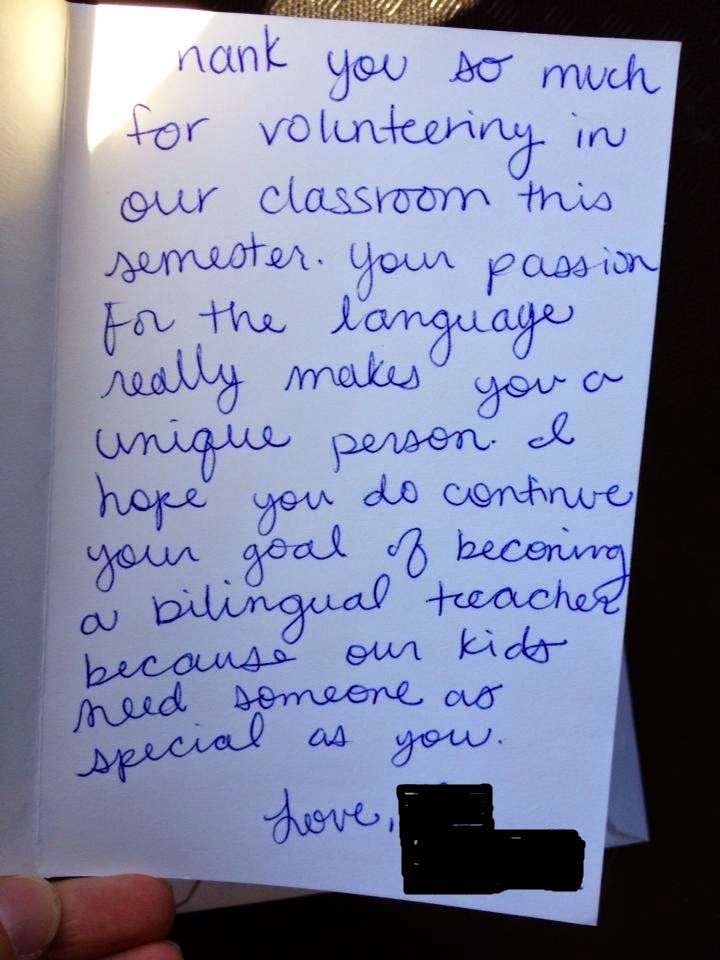
Encouragement and thoughtfulness from a community partner to a student. by Ann Abbott My student received this card from her community partner. She was excited and moved. Our words have such a powerful effect.

New Book about Language Teaching and Social Justice

Image
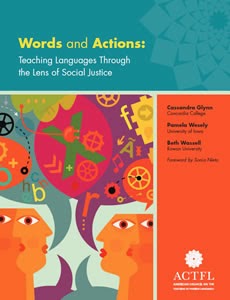
Click on the picture to order. by Ann Abbott I just ordered this book and look forward to reading it. Words and Actions: Teaching Languages Through the Lens of Social Justice by Cassandra Glynn, Pamela Wesely, and Beth Wassell According to the authors, a social justice curriculum positively influences all students. Social justice, critical pedagogy, and culturally relevant teaching are becoming essential as more and more language educators teach in increasingly diverse world language classrooms. This new publication supports in-service and pre-service teachers in recognizing their students' diverse backgrounds while also supporting students' ability to think critically about the world around them. Questioning mainstream approaches to language and culture learning is vital. An emphasis on social justice is, in part, a way to expand the definition and scope of language education, leading to further innovation in the profession.

Methods Proseminar: Introduction to Community Service Learning and Languages for Specific Purposes

Image
by Ann Abbott 1. Main take-aways 2. What is community service learning (CSL)? Service that meets a community-identified need. Service enhances the academic content of the course. Structured student reflections. (5 Cs) Identify and highlight those elements within the SPAN 232 "Spanish in the Community" Syllabus . How would you alter the example in the first slide of "What is Service Learning?" to make it pertinent to a Spanish course? 3. What do you do in class? How would you respond to these statements ? ¿ QuiĆ©n es Dayani Cristal ?  How can we make the trailer work in a beginning Spanish class? How can we empower students to enter the dialogue ? What do you have to say? 4. What is languages for specific purposes (LSP)? Student career concerns and aspirations from Ann Abbott 5. What is your main take-away?

A Proposal to Teach a Short, Short Class on Spanish and Social Entrepreneurship in a High School

Image
by Ann Abbott  My daughter is a sophomore at University High School in Urbana , and every year they have Agora Days: "Another example of creative freedom is Agora Days, a four-day school week in late February when students, parents, faculty, alumni and friends of the school can teach hour-long classes about a wide range of topics. Students are required to take a number of academic-oriented classes, but classes based on playing sports and watching films or TV series also exist. Students have the same eight-hour schedule on each of the four days. Agora Days has been a Uni tradition since 1977." (From the Wikipedia page about Uni High .) This year I decided to put together a proposal. Let's see what high school students think about social entrepreneurship and languages. Do you think the proposal will be accepted? Do you think students will be interested in the topic? Do you think I should have gone with something like "Socially-Conscious Latin American Musici...

Spanish Community Service Learning, Civic Engagement, Transcultural Competence and Technology

by Ann Abbott In two weeks I will visit the University of South Florida in Tampa for their campus' Service Learning Day . I had a wonderful conversation with Lance Arney and Dr. Soria Colomer about what they and their colleagues would like to hear about and discuss. It became clear very quickly that people want to know more about how to help students engage with people of different cultural backgrounds in effective ways. And we are not just talking about national cultures; students need to be supported as the encounter many kinds of difference in their community service learning work so that they can understand, learn and grow. Lance put together the following to send to faculty, and I wanted to share it because I think it is very well articulated and shows us what faculty really want to learn, what barriers they feel they need to overcome in order to do service learning and do it well. Keynote speech: “Don’t Just Teach! Engage Students in Communities”: Engaging Studen...

Student Spotlight: Marlee Stein

Image
by Ann Abbott Like many students, Marlee Stein took advantage of many opportunities available to Spanish students, perhaps not sure how they would all add up or where they would lead. Marlee did the following: Studied abroad in Granada, Spain. Took the community service learning courses ("Spanish in the Community" and "Spanish and Entrepreneurship"). She did James Scholar Honors projects in her Spanish courses. In my classes, one semester she blogged (on this blog) and another semester she worked on a virtual intercambio  site-- got it up and running. She applied to teach English in Spain through the  Cultural Ambassadors: North American Language and Culture Assistants in Spain program. She was accepted, and she extended her stay into a second year. Along the way, she figured out for herself how all of those experiences added up, where she wanted them to lead her. Here's a message Marlee recently sent me. I wanted to tell you that I was accepted ...

Engaged Teaching Leads to Career Opportunities for Students

by Ann Abbott I believe that... ...universities are places of learning . That comes first. They are not vocational schools. And they are not businesses in and of themselves. ...learning should be broad . Yes, there should be a foreign language learning requirement for everyone. Yes, all students should have to take a course on non-Western cultures. Yes, math and science are for everyone--even though I thought I was going to flunk Chem 101 my freshman year. ...learning should take place inside and outside the classroom.  Going to a foreign film festival is part of your university learning experience. Visiting a campus art museum, attending a student-produced play going to a concert are all learning experiences. When you're a student in a place where learning is the central mission, you don't stop learning when you leave your class. ...encountering "difference" is one of the most important things students should do.  It's so important, that students should s...

Florencia Henshaw: Building Accountability into the Task-Based Classroom

Image
by Ann Abbott Ever had a colleague whose work you admire, whose skills complement yours, and yet your work overlaps and--let's be honest--she so pushes you, too? I think that's a rare combination.  That colleague, for me, is Florencia Henshaw . So when I began to think about my social entrepreneurship for next semester and how I wanted to do a few things differently, it finally dawned on me to ask her for help. Here is our email conversation: My question Dear Florencia, Una pregunta: since you are teaching [the methods course] in an active way, not just sitting around discussing the readings, how do you know if students are doing the readings or not? I'm trying to think of better ways to build in accountability to my entrepreneurship course for next semester and thought you might have some insights. Ann Florencia's answer Hi Ann, I usually do so in the form of: a) creating questions/activities based on sections of the readings for their classma...

My Syllabi: Business Spanish, Spanish & Entrepreneurship and Spanish in the Community

by Ann Abbott Sometimes I am very slow to respond to simple requests. When Carolina EgĆŗsquiza ( @ cegusquiza ) let me know  that the links on my blog to my course syllabi didn't work, that seemed like an easy thing to fix. But I just fixed it today. So here are my course syllabi and calendars. While I'm always tweaking the courses, these documents at the main elements of the course.  You'll also find the links on the left-hand side bar. Would you like to share your syllabi, too? I'd love to see them and learn from them. Just add a link in the comments below. "Spanish in the Community" a community service learning course with relevant languages for specific purposes content "Spanish & Entrepreneurship: Languages, Cultures & Communities," a community service learning course that focuses on social entrepreneurship within specific languistic and cultural communities "Business Spanish," a combination of traditional...

Quick Cover Letter Advice for Recent College Graduates Who Lived Abroad

Image
by Ann Abbott Some quick, quick advice before I start my work for the day: Make sure the cover letters you write for jobs are more about the specific job you are applying for than the jobs you previously had.  Yes, that means you need to customize each cover letter. Sorry. I know how much work that is. I really do. Yes, that means that you need to use the same words they use in the job ad. They want to know you can do those things. Other things are good, but first you have show them that you are able to do those specific things that they listed in the ad. Yes, that still means that you should elaborate by using specific examples, very specific examples, from previous experiences. Just remember that you are really using those specific examples to talk about this new job even though they are about your old job. Here's what I wrote to a student: I love the rich experiences you describe in your cover letter about your time in [another country]. However, I think the cove...

Student Spotlight: Julie Lucas

Image
Ÿby Ann Abbott I'm just so proud of my students and the wonderful things they go on to do after graduation. Julie Lucas--she will always be Julia to me--is one of those students. Take a look at what she did while she was a student, the program she went on after graduation, and her plans for the future. Would you would like to follow in Julia's footsteps? Spanish  Julia was in my SPAN 332 "Spanish & Entrepreneurship" course. She worked at both the SOAR after-school program and with Vida Alegre. For her community-based team project, she worked on a marketing project for the University Language Academy for Children. Spain After graduation, Julia spent two years in Spain, teaching English through the Embassy of Spain.  Here are her own words about her experiences: Hola Ann, Vivo en Salamanca, y este curso serĆ” mi segundo enseƱando en el mismo colegio que el aƱo pasado. He vuelto porque me encantó la experiencia que tenĆ­a el aƱo pasado y ...

Student Spotlight: Amanda PeƱa

Image
by Ann Abbott With some of my former students, I know what is going on in their lives because we are connected on Facebook. I see their pictures, hear about their jobs and watch their lives unfold. With other students, I am aware of their development as professionals because we are connected on LinkedIn. I get to see where they work, what industry-related information they post, and watch them grow into new positions and jobs. Amanda PeƱa is in the second category. She was a student in my "Spanish & Entrepreneurship" course, and she now works for a marketing company. I recently corresponded with her, and she gave me the following information to share. My hope is that her experiences will inspire current Spanish students to see what opportunities they should take advantage of while they are still students and what career path they might take after they graduate. Here is Amanda's story. Look for ways in which you can follow in her successful footsteps. W...

Fun, Engaging Classroom Activity for Students to Debate about Bilingualism and Immigration in the United States

Image
"Spanish in the Community" students doing today's activity. by Ann Abbott This week students in my "Spanish in the Community" course were assigned to watch my friend and colleague Kim Potowski's video, No Child Left Monolingual  (watch it; you'll enjoy it!), and one of her articles, "Sociolinguistic Dimensions to Immigration"  Lengua y migración 5:2 (2013), 29-50. Before class, I wrote down note cards with things Americans often say--awful things about languages and cultures or things they are simply confused about: I came to this university to study computer science, not Spanish. Why am I required to study a language? That makes me mad! I'm not Irish-American; I'm just American. I don't believe in all this "heritage" baloney. My great-grandpa came from Germany and learned English. Why can't these Mexicans just learn like he did? If we don't all speak the same language, everything will just be utter c...