Posts

Chancellor Phyllis Wise "Gets" Public Engagement

Image
Chancellor Wise sets a strong, positive example for everyone at the University of Illinois, Urbana-Champaign. This initiative is just one moe example of her leadership. by Ann Abbott It is very encouraging to work in a university in which the Chancellor seems to really understand what public engagement is and its importance. For us. For others. For students. For faculty. For image and branding, sure. But also for real exchanges of information and intellectual advancements that wouldn't happen in other ways. We received the message below from Chancellor Wise today. I feel that her voice from above frames the work that my Spanish students do in their community service learning. It legitimizes, in a way, their service to our local Spanish-speakers. It echoes the importance that they find in their work beyond campus. I also hope that our department--the Department of Spanish, Italian & Portuguese--can come up with a project that reflects our commitment to languages a...

What Comes after Spanish Community Service Learning?

Image
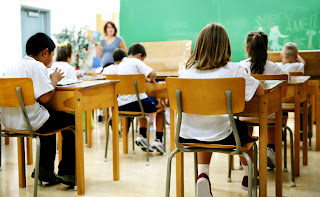
We need people who can negotiate among languages, national cultures, subcultures and school cultures. by Ann Abbott Two educational situations in particular seem to evoke strong reactions from my Spanish community service learning students: Students who have worked in a bilingual classroom throughout the semester are shocked by what happens when the class has a substitute teacher who does not speak Spanish. Gradually, over the course of the semester, my students become accustomed to a classroom atmosphere in which learning took place in Spanish or both Spanish and English. Then all of a sudden, one day, with a monolingual English-speaking substitute teacher, they see the learning and classroom discipline come to a screeching halt. My students often jump in and play very important roles in those situations, surprising even themselves at how much they can contribute. Students who have done their community service learning work in a school or with any other type of community par...

Why Emigrate? Answering This in a Spanish Community Service Learning Class

Image
Our public discourse presents immigrants as criminals, not as people escaping  out-of-control "criminalidad." by Ann Abbott We have an economic public discourse on immigration in this country. And a criminal discourse. We do not have a humanitarian public discourse on immigration. Not even a humane one, really. So when students come to our Spanish community service learning courses, they bring with them the weight of that dominant discourse. That is, whether they are pro-immigration or not, the terms in which our students engage the topic of immigration reflect our dominant public discourse: the economic costs-benefits of immigration and the criminalization of the act of migration. This is not our students' fault, of course! It is simply our responsibility to broaden their thinking on the topic. Lesson 14 in Comunidades   is titled ¿Por qué emigrar? It shows students that there are myriad reasons for which people make the difficult decision to leave behind the...

Live and Work in Spain: Language and Culture Assistants

by Ann Abbott I hope that all my students will consider applying for this. Dear Professors, Instructors and Administrators, The Education Office of the Embassies of Spain in the United States and Canada is proud to announce the opening of the application period of the Language and Culture Assistants Program in Spain. This wonderful program allows recent college graduates, and even juniors and seniors, to spend a year or two in Spain working as English or French Language Assistants in Spanish K-12 schools. Please, take a look at the website of the program and at the Application Manual, and feel free to distribute it amongst your students and your community. We anticipate a large number of assignments for 2013-14:  http://www.mecd.gob.es/eeuu/convocatorias-programas/convocatorias-eeuu/auxiliares-conversacion-eeuu.html Attached you will find the promotional brochure of the program, which we hope you and your students will find informative. The application period opens ...

Student Reflection

Image
by Flora Ramirez With the semester finally coming to a close, I can genuinely say that I am grateful for all of my experiences with both La Línea and CLACS. While both experiences were very different from one another, they were able to further inform my personal interests in very unique ways.   My work with CLACS “Story Time” helped me value culture.  I realized the importance of exposing children to other cultures and the positive impacts in can have. By creating this sense of awareness, parents and teachers can begin to foster respect for people of various backgrounds. To some extent, my time at CLACS even taught me to further value my own culture and my parents’ success with passing down our traditions and language to me. Even though my time with La Linea was short, I felt extremely involved with the two cases I was part of.  Here, I realized how important my language and culture was in terms of making myself personable to community members.  I...

Student Reflection

Image
by Megan Creighton Un Abrazo Fuertísimo My time as an undergraduate came to a close today after I handed in one final paper. I had toiled over this research throughout the entire semester and spent the last two weeks almost entirely devoted to writing my paper on it. It was the last remaining requirement for my anthropology degree, and I had always imagined that the moment of completing my senior capstone would be triumphant and rewarding. So I finally finished my paper early this morning, and I trudged through the violent wind and rain to at last hand it in. When I left the building, there was no big “hurrah” or celebration. Besides experiencing some moderate sense of relief, I left the building feeling quite underwhelmed. In this last week as an undergraduate, I experienced many “lasts”.  I spent hours finalizing this last paper. I took one last written final. I worked my last shift at my student job. I used my I-card for the very last time. But the only “las...

Student Reflection

Image
by Daniel Cox [My apologies, this post appears out of order because I accidently posted it to a different blog. So, here is a look back at the earlier days of this semester and Daniel's experience with his community partner. --Ann Abbott] My transition to the office My community project this semester involves interpreting, translating, and general clerical work for the Frances Nelson Dental Center through Smile Healthy. I initially chose to complete my volunteer assignment through Smile Healthy because I had not previously used my Spanish in an office setting. Throughout my first three years at the University of Illinois, I’d spent several hours in a classroom setting, assisting ESL students and tutoring students in Spanish. That being said, Smile Healthy offered the opportunity to try something new:  working with Spanish speakers over 17 years old and using a set of vocabulary that I usually do not use. One of the hardest challenges I’ve faced was adjusting to the ...

Student Reflection

Image
by Flora Ramirez With the end of the semester just around the corner I decided I would try and pair up with a second community partner in order to fulfill my required twenty-eight hours of service for this class. I decided to get in contact with La Linea .  This is a pilot program at the University YMCA that is staffed by volunteers that provide phone information service in the form of basic translation and interpretation. I was particularly drawn to this group because I had worked with them as a sophomore when the program was initially taking off.  After contacting Francisco Baires, the Community Programs Director, I was able to meet with him and another volunteer by the name of Carolina.  During our meeting we discussed what La Linea had evolved into in my absence and what our own person abilities could bring to this program.  Having explained to them my interest in speaking more with immigrant community members they then presented to me a new case they were ...

Activism and Community Service Learning: Providing Models to Our Students

Image
An example of how engaged citizens organize and interact with their representatives to enact social change. by Ann Abbott One of my goals this semester while teaching "Spanish in the Community" was to enhance my emphasis on civic engagement. In a way, it came easily because this semester coincided with the Presidential election. However, I want students to see that they can become active citizens, even activists, outside of the polls and beyond national issues. In future semesters I will use the image above to build a lesson plan including the following points: Students research what legislation is pending now. Students research what politicians on this list are still in office, which are not. Students research what happened with the bill that is listed. Students produce a script about an item for which they want to advocate now. Advocacy can seem like a mysterious concept, a mysterious process. Messages like the one above demystify the process and give stude...

Student Reflection

Image
by Flora Ramirez While I am still working with CLACS, I am consistently spending more time working with La Línea.  I must admit that I underestimated the fast-paced nature of this position.  This is derived from La Línea’s genuine understanding that life is unplanned.  Thus, they tailor their services to meet the unpredictability that characterizes the lives of individuals. This means that the hours of operation are more flexible and prompt responses are crucial.    Even though the variance in the hours of operation can make it difficult to keep track of my hours, I appreciate how closely this position reflects real life community activism.  The duties entailed at La Linea never appear to remain static. By these I mean that people can call about real life problems and so their concerns are wide-ranging. I will confess that when I realized people could call to ask for help with just about anything, I was a bit apprehensive. However, I soon r...

Student Reflection

Image
by Michelle Lee When you walk into the second grade classroom, there is a bulletin board about the various attitudes that are conducive to a healthy learning environment. From the photo, examples of these attitudes include respect, enthusiasm, empathy, and integrity among many others. Not only are these qualities important for the students in the development of their character, they are also crucial for tutors and other community volunteers to possess as well.   These sheets of paper are posted all throughout the school on bulletin boards in the hallways as well as at the main entrance. I was actually surprised that these kids were already learning very advanced words that I feel like I learned in middle school! One word that stands out to me the most is integrity; I see it everywhere, which suggests that it is something that is stressed a lot at Garden Hills. Telling the truth is something that I find extremely important to working in the community for both volunteers and...

Student Reflection

Image
by Michelle Lee During the last week of SOAR, the students made the tutors cards thanking us for working with them this semester. Working at SOAR for the past semester has given me a lot to think about. Initially I requested to work with fourth and fifth graders, but I never thought that I would be comfortable working with such young children. In the beginning of the semester I was very nervous because although I enjoy teaching, I do not like working with any children younger than high school age because I had a bad experience in the past teaching English to third graders in China. However, through SOAR, I was able to find greater comfort in teaching young children and have changed my perspectives on this. SOAR has taught me how to have more patience working with young children, especially those who attend school in the United States and whose native tongue is a language other than English. I have greater appreciation for the efforts of elementary school teachers who work with t...

Student Reflection

Image
by Daniel Cox Building Confidence Throughout the course, we emphasized the importance of building our confidence in order to communicate with members of the community in both English and Spanish. On our final day of class, we all agreed that, rather than our actual Spanish skills, it was our confidence in using those skills that had increased most. I started to consider how my own level of confidence had changed throughout the course. In terms of my Spanish use, the actual use of usted rather than tu was an aspect that I really needed to improve. On paper, the concepts make sense and I can apply them with ease. However, in reality, using the usted form for sentences or phrases that I almost always use with the tu form. For example, with many patients, I would spend a few minutes before the doctor arrived, speaking with them about general topics, their family, work situations, etc. These conversations broke the mold of the typical four-question interactions in the offi...

Student Reflection

Image
by Erik Bingham The End of the Start It is already almost the middle of December and the semester is coming to an end much quicker than I had thought it would. It still feels like I just started working at ECIRMAC even though I have volunteered there almost thirty hours already. While I have finished my required 28 hours for the semester, my work in the community is far from over. I have already asked one of my supervisors if I could come in next week sometime when I am not studying or writing papers and she said she would never say no to extra help. I’m planning on going in at least twice next week like I normally do but if I am extra productive and don’t have to work on my final papers then I might go in another day as well. Next semester I am going to take Spanish and Entrepreneurship, which is the second class in the series of Spanish in the community at the University of Illinois. I am genuinely excited for this class because I am assuming that it will expand on what we have...

Student Reflection

Image
by Michelle Lee Earlier last month, the students learned about the many ways to say “hello” in different languages. They excitedly greeted me in choruses of “Shalom!” and “Ni hao!” to show off the new words they had learned. These notecards are taped on the wall right by the classroom door so they are visible to everyone who enters and leaves. This incident reminded me of the importance of diversity and the acceptance of different languages and cultures not only in the classroom, but also in the larger community as well. Although the students in the SOAR program are all Spanish speakers that come from Latino/a descent, there are other students in the class and school that come from very different backgrounds. Similarly, the local Champaign-Urbana community is made up of very distinct people, and it is their diversity that has helped mold the places they live and frequent into what they are today. Cultural diversity begins with acceptance, and as SOAR tutors we must learn to a...