Posts

Showing posts with the label spanish

Student Reflection: Why Take SPAN 332 "Spanish & Social Entrepreneurship"?

Image
Wole en frente del Centro para Refugiados by  Olawole Daramola  Hola! El curso  SPAN 332 explora el concepto de emprendimiento social en un contexto latinoamericano. Se aprenden las injusticias en el sistema político contra inmigrantes sin documentos. Además, este curso revela oportunidades para transformar estructuras injustas de la sociedad y es un espacio para pensar sobre innovaciones de valor. Además, cada estudiante tiene un sitio donde ellos ayudan la comunidad latina en muchas formas diferentes. La clase proveerá conocimiento suficiente para navegar y entender las dinámicas de cada organizacion en comunidad donde se trabaja. Por ejemplo, si trabajas en El Centro para Refugiados sabrás tener más paciencia y compasión por los clientes porque en la clase escucharás sobre las barreras que enfrentan los inmigrantes. Éste es el sitio donde yo trabajé. Aprendí mucho en este curso y estoy muy feliz de haberlo tomado. Primero, mejor é  mi español--m...

Connecting College Students with Alumni: A Classroom Networking Project

Image
Look below to click on the links from the slide above. By Ann Abbott  On Friday I will give two talks. One is a noon-hour workshop on service learning, and the other is a quick description of a classroom project for our School's Share Fair . Here's what I will share in the second talk. Connecting Students with Alumni: A Classroom Networking Project Making the transition from language student to working professional can be a difficult and mysterious process to our current students. In my Business Spanish course, students work on a networking project that connects them to former students who were in their seats just a few years ago but are now in the working world. I will share the specific steps and resources I use for this activity—from researching alumni LinkedIn profiles to writing a “cold” networking email. This activity can be adapted to any language and any course.  On their end-of-the-semester course evaluations, several students listed this project as o...

Language Teaching Tips: The First in a Series of Short, Focused Tips

Image
One Instruction at a Time: A Teaching Tip for Foreign Languages from Annie Abbott by Ann Abbott On this blog I usually tackle "big picture" items. I think a lot about what a Spanish major should look like in the US today. I use it as a platform to hopefully make Spanish community service learning more accessible to anyone thinking about teaching with it. I want to share my students' reflections so they have a strong voice in how we construct (or don't) our courses. I'd love it if Business Spanish and specific topics like social entrepreneurship and bilingual social media marketing gained resonance in our field. But I started out, many years ago, as a course supervisor. Of SPAN 101 and 102. That was my first gig. I worked on the syllabus, did classroom observations, put together tests, soaked up ideas from my professors and mentors, and much more. I had to pay attention to the little things that make classes work. And even more specifically, that ma...

Life Long Language Learning: Online Tools for Portuguese Learning

Image
by Ann Abbott I say it all the time: I love hearing from former students! Especially when they tell me that they are still using Spanish and are interested in continuing their learning. This week I received this email from a student: Hi Ann, I'm not sure if you remember me or not, but I am a former student of yours (like six or seven years ago). I saw you on LinkedIn the other day and have been thinking of trying to pick up Portuguese lately so thought I'd reach out for some direction. I would like to take an online course for credit somewhere to keep me motivated and on task. If you have any insight and advice (and also time haha) please let me know. If you know of any similar advance Spanish courses like that I'd be interested as well. I've been using it a lot and there's always room for improvement!  Unfortunately, I don't have good answers to the specific type of learning experience he's looking for. I understand signing up for a for-cred...

Undocumented Immigrants: Invisible in Our Community, Invisible in our Curriculum

Image
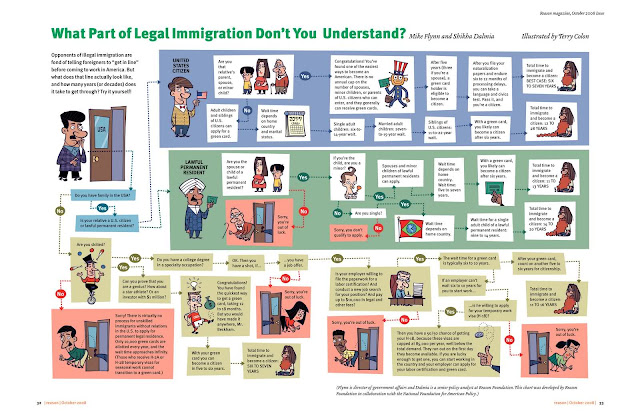
This flowchart makes the information very clear: there is no "legal path" for anyone except the very privileged. by Ann Abbott Florencia Henshaw invited me to speak to her students in SPAN 308 " Spanish in the US ," and I was delighted to do so. I think we need even more of an emphasis on Spanish in the US and that students need to understand better the complex realities of Spanish and Spanish speakers in the US. The topic of the week was "El e spa ñol en la vida pública." I don't know exactly how she was planning to frame that topic, but I decided to talk about our public discourse towards undocumented Spanish-speaking immigrants and our public policies related to them and their lives. I'll share my notes and resources below in a list format. I only had twenty minutes to talk, and I didn't take the time to structure this as a lesson like I normally would. But maybe something here will strike you and you could develop an actual lesson...

Spanish and Social Entrepreneurship: Week 10

Image
We focus on social entrepreneurship that is linguistically and culturally appropriate, with 28 hours of service learning. Week 10 by Ann Abbott Semana 10: El riesgo Martes We talked about ethics. Why? Because people normally think about risk as a financial game that entrepreneurs play. Sometimes they win. Sometimes they lose--and lose big. But with social entrepreneurship, losing your reputation is one of the biggest risks for the organization.  As always, we spent the first five minutes of class in paired conversation. Like I always say, in community service learning (CSL) classes, students have to be able to start and maintain conversations in Spanish, often out of thin air. Those five-minute "hablar sin parar" activities are very important. I transitioned us to our topic--ethics--and emphasized that compliance and ethics are two different things. Just because you are not breaking a rule or a law does not necessarily mean that you are doing the most et...

Experiential Activities for the Spanish Community Service LearningClassroom

Experiential actitivies for the csl classroom from Annie Abbott Because a lot of language educators believe that community service learning (CSL) is only for Spanish, it's so nice to be friends and colleagues with Deb Reisinger from Duke University who does CSL with her French students. (She also does business language studies and teaches social entrepreneurship; we have many, many things in common.) I'll be visiting her and her colleagues at Duke next week, and I'm excited to see their campus for the first time and learn more about their engaged scholarship and teaching projects. Although our universities are quite different (public/private) and in different places (small city Midwest/bigger city South), we actually are both part of the "New Latino Diaspora," a phenomenon that has the potential to radically shift how we teach Spanish in higher education in the US. (There might be a similar phenomenon for French speakers, particularly from the Fren...

Spanish and Social Entrepreneurship: Week 8

Image
We focus on social entrepreneurship that is linguistically and culturally appropriate, with 28 hours of service learning. Week 8 by Ann Abbott Semana 8: Medios sociales Martes ¿Qué importancia tienen los artistas solidarios para las causas que apoyan?  ¿Es Angelina Jolie una artista solidaria?   Lee esta página web y analiza las ventajas y desventajas de utilizar las grandes artistas para llamar la atención a una causa . ¿Qué causas apoyan estos artistas latinos?   Mira el video y haz una lista de los artistas que aparecen y la causas que apoyan .  ¿Qué es una fundación?   Echa un vistazo a este documento  y luego explica la diferencia entre una fundación y una organización sin fines de lucro. ¿Qué tipo de branding hace Ricardo Arjona para su Fundación Adentro?  El branding es importante para las empresas sociales. Analiza esta imagen de Ricardo Arjona y el poster de su Fundación para lue...

Sharing Good Ideas among Language Programs in the CIC

Image
My notes from the CIC meeting of language program directors. by Ann Abbott It's good to have a peer group. You can share and compare because you know that you're in similar situations. And that's what the CIC annual meeting of language program directors and executive officers is all about. (Although I'm not a language program director, I am the Director of Undergraduate studies; that's why I go.) But the things driving our discussions--helping our students learn the most possible, integrating technology intelligently, combating declining enrollments, and running large programs effectively--concern all language educators. So I'll share some things here. In the interest of privacy, I'll keep things very general, and I won't share the names of the university or person who presented the ideas. Hopefully you can find one or two things that could help your language program and courses. There's no particular order to this list. Course titl...

Medical Spanish: Where Are We Now?

Image
by Ann Abbott More and more I come to the conclusion that approaches like "Medical Spanish," "Business Spanish" or "Spanish for Social Workers" is the wrong approach at the undergraduate level at a university like mine, the University of Illinois, Urbana-Champaign. I have written about this ( see especially my 2014 with Barbara Lafford and Darcy Lear ). It's too soon to specialize. It's useless to memorize long lists of overly-specific vocabulary that students might or might not use in the future. (Who knows if they'll even be accepted into medical school? Or get a job in marketing? Or stick around in social work for more than a couple of years?) What we could do--and do very well--is the following: Spanish language.  Work on students' Spanish proficiency. There is no magic bullet, but our classes should be designed to help students along that path and study abroad (especially one-year programs) should be encouraged. Community-bas...

Reflection Prompts to Guide Your Community Service Learning Course Design

Image
by Ann Abbott During the 2014-15 academic year I traveled to many universities and met many creative people doing very meaningful work with their language students. I also took a very careful look at many course syllabi. They all were interesting and reflected the instructors' deep subject knowledge and intellectual curiosity to take a journey with their students. That is the kind of course we would all like to create! There were also red flags for potential issues in community service learning (CSL) courses. I don't have all the answers, of course, and my course design can look very different from someone else's and yet both be very successful. Still, in the spirit of critical reflection that is the backbone of a good CSL learning experience, I offer a few key questions that you can ask yourself about your CSL course design. What is the organizational capacity of your community partner(s)? You need a true partner, so ask yourself these questions. Does this ...